Most Tri-Cities Tree Companies Remove Dead Trees. We Keep Them Alive.
Diagnose problems early and protect your trees
Borers, disease, drought stress, and poor soil are killing trees across the Tri-Cities — often long before the owner notices. Most of it can be diagnosed and treated, usually for a fraction of what removal and replacement would cost. Our Plant Health Care program is directed by ISA Certified Arborists. This is the work almost no one here does well. We do.
If Your Tree Is Showing Any of These, Do Not Wait
- Leaves are thinning, yellowing, or dropping early.
- You see small holes, sawdust, or D-shaped exit wounds in the bark. That is a borer.
- Branches are dying back from the tips.
- The birch, ash, or pine you love does not look right this year.
- Mushrooms are coming up at the base of the trunk. That can mean decay inside.
Caught early, most of these are treatable. Caught late, they are a removal. The difference is a phone call. And if a neighbor’s trees are declining, that is worth a call too — preventative care costs a lot less than waiting for the problem to reach your property.
A Mature Tree Takes Decades to Grow. Protecting It Takes a Season.
A mature tree shades the house, holds up the landscape, and cannot be replaced on any schedule you would choose. Treating a birch against bronze birch borer costs a fraction of removing it and starting over with a sapling — and the sapling spends thirty years catching up. Preventative care is not an upsell. It is the cheapest way to keep the trees you already have.
What we handle
Diagnosis, Treatment, and a Plan to Keep It Healthy
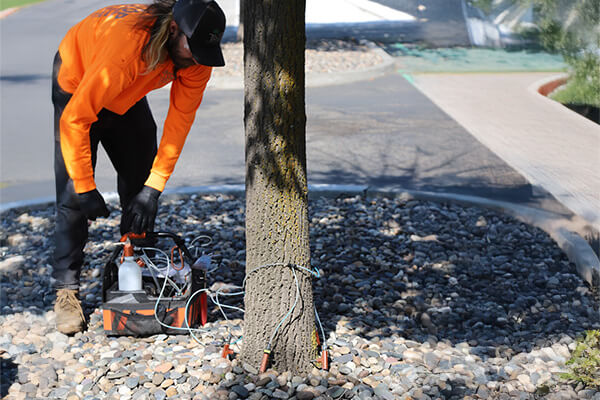
We diagnose and treat insect problems (borers, aphids, mites), common diseases, and nutrient and soil issues — for trees and for shrubs and ornamentals. Where it makes sense, we set up a seasonal treatment plan so problems get caught before they start.
- A Dedicated Plant Health Care Division
Top Tree has run a dedicated Plant Health Care division since 2020 — this is not a sideline we bolt onto removals. Diagnosis and treatment are directed by our ISA Certified Arborists, Ryan Hone (#PN-8664A) and Robert Wellington (#PN-384050A); a dedicated PHC technician handles the visits and performs the treatments. Plant health care is judgment work — the wrong treatment wastes money and can hurt the tree. The credentials behind the plan are why you can trust the call.
Questions People Ask About Tree Health
How do I know if my tree is sick?
Thinning or yellowing leaves, early leaf drop, branches dying back from the tips, and small holes or sawdust on the bark are the signs we see most. Any of them is worth a photo and a phone call — early is cheap, late is a removal.
What are the little D-shaped holes in my birch?
That is bronze birch borer, the pest killing birch trees across the Tri-Cities. Caught early it is treatable; caught late the tree usually cannot be saved. If you are seeing exit holes, do not wait a season.
Is treating a tree really worth it?
A mature tree takes decades to grow and shades, shelters, and holds up the value of your whole yard. Treatment costs a fraction of removing a tree and starting over with a sapling. And if treatment will not work, we tell you that too.
When does treatment happen?
It depends on the pest and the treatment — many treatments go in during spring and early summer, ahead of the insects’ active season. That is why we set up seasonal plans: the right treatment at the right time, without you having to track it.
Send a Photo to Help Us Prepare for Your On-Site Evaluation
Request a Free Estimate
Fill out the form below, and we’ll get back to you as soon as possible.